


Literature study: Heat stress combined with ZEN exposure causes extensive changes in protein expression in the ovary of gilts......
Release time:
May 04,2024
Test Design and Grouping
• Test sows
38 gilts, each weighing 61.5kg ± 0.5kg,105-115 days old.
• Test factors
Appropriate temperature: TN21 ℃ ± 0.1 ℃,68% RH;
Heat stress: 12h cyclic heat stress, 7: 00 a.m. -7: 00 p.m. 35 ℃ ± 0.2 ℃, 42% RH, 7: 00 p.m. -7: 00 a.m. 32.2 ℃ ± 0.1 ℃, 40.7 RH, 7: 00 p.m. the next day for 7 days;
Toxins: Zearalenone (ZEN) was added to the vehicle at a dose of 40 μg/kg/body weight to the test sows, while the control group was fed the same dose of vehicle, and the vehicle was 10g biscuit.
• Test grouping
Taking into account the heat stress will lead to a decline in feed intake, so the temperature group and then divided a part of its feed intake and heat stress group pairing, in order to avoid the difference caused by the difference of nutrient intake. Test grouping is shown as follows:

• Test time
Test a total of 7 days.
Test results
In this experiment, the effects of heat stress and ZEN exposure on the ovaries of adolescent females were investigated using the reserve pig as a model, so the designed ZEN dose was lower than the toxic dose, and the test time was short, only 7 days. Despite this, the experiment found changes in the expression of several proteins in the ovaries.
Under the condition of suitable temperature, the expression of 84 ovarian proteins was changed by low dose and short time exposure of ZEN in gilts, mainly involving sec61 transport complex, rough endoplasmic reticulum membrane, proteasome complex, asparagine metabolic pathway, aspartic acid family amino acid metabolic pathway and cellular amide metabolic pathway.
Under the condition of heat stress, low dose and short time exposure of ZEN in gilts caused the expression of 108 ovarian proteins, which were mainly involved in the cellular pathways related to the alpha subunit complex of the proteasome core complex, the fiber collagen trimer, the proteasome complex and the splicing complex.
Although the changes of ovarian molecular metabolism caused by ZEN are different at different temperatures, they are generally related to ovarian antioxidant, cell apoptosis, estrous cycle, luteolysis and ovarian aging, and the changes caused by heat stress and ZEN exposure are more extensive.
Original:
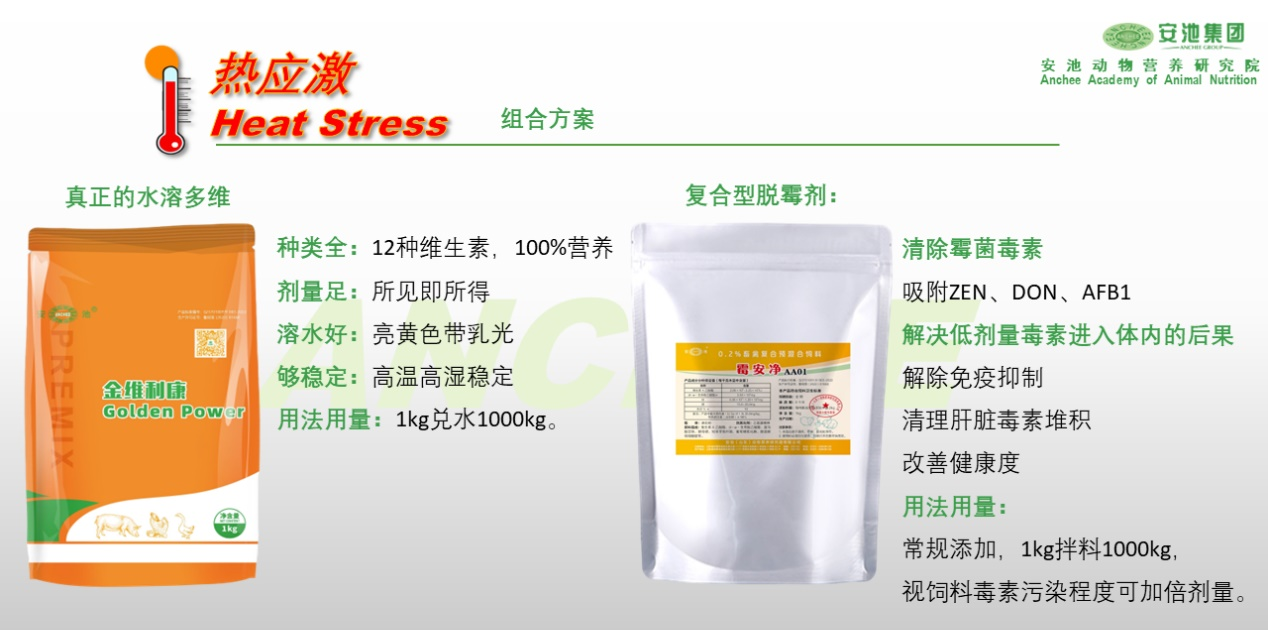
Therefore, Jinweilikang Golden Poewr mold Anjing was recommend as the best combination to prevent the effect of low-dose mycotoxins on the reproductive performance of sows during summer heat stress.
More content
A
A
A
A
A
ANCHEE GROUP
TelPhone: 86-531-88771588
Fax: 86-531-88771898
E-mail: ac@anchee.com
Office address: Floor 25, Building 5, Lushang Guoao City, Lixia District, Jinan City, Shandong Province